
Filming Ion Mândrescu: Bronze, Fire and the Silence Between Words
What filming Romanian sculptor Ion Mândrescu taught me about atmosphere, observation and the difference between documenting a person and truly seeing them.
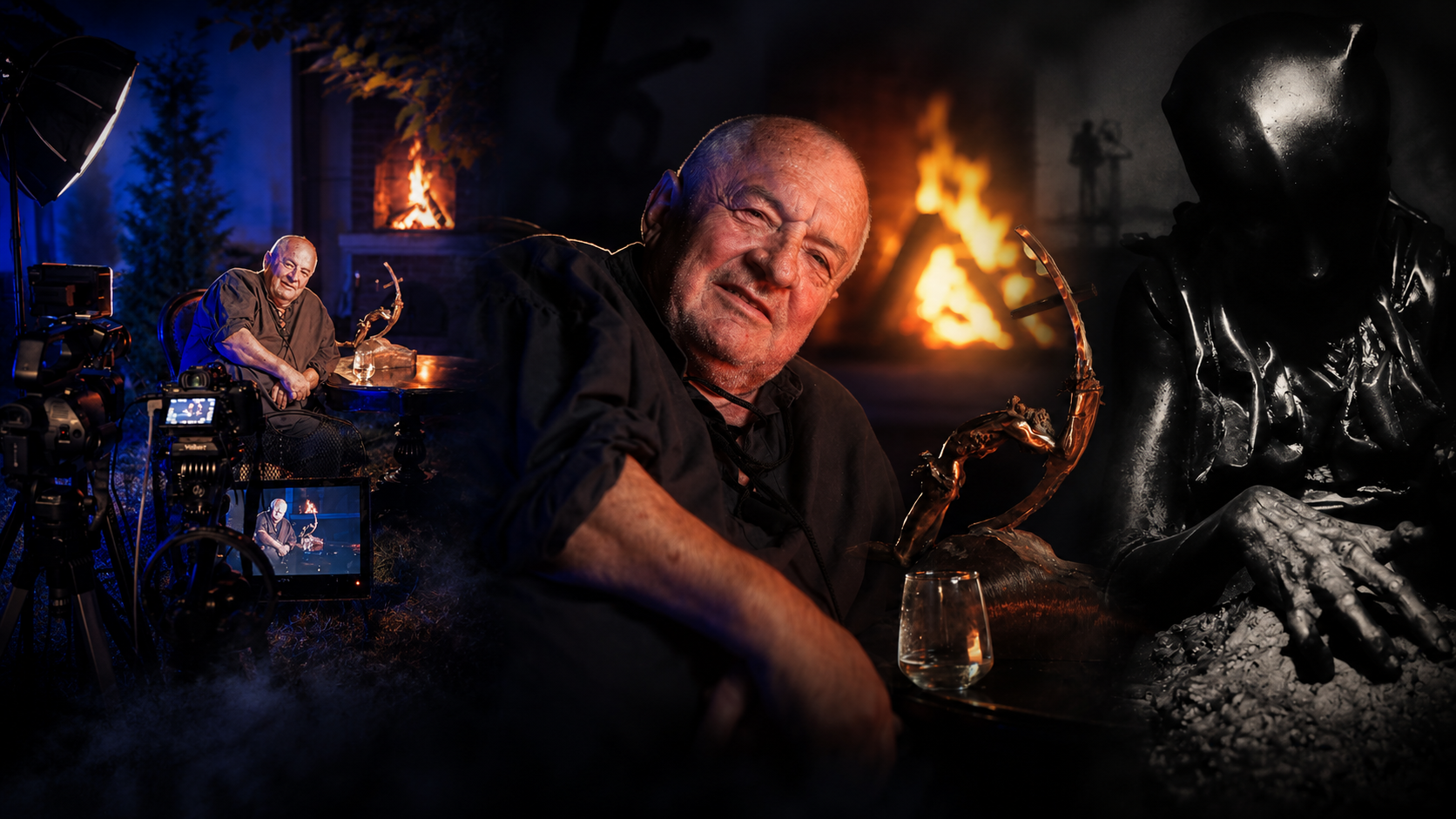

There are subjects that speak easily to the camera, and subjects that resist it.
Sculpture belongs firmly to the second category.
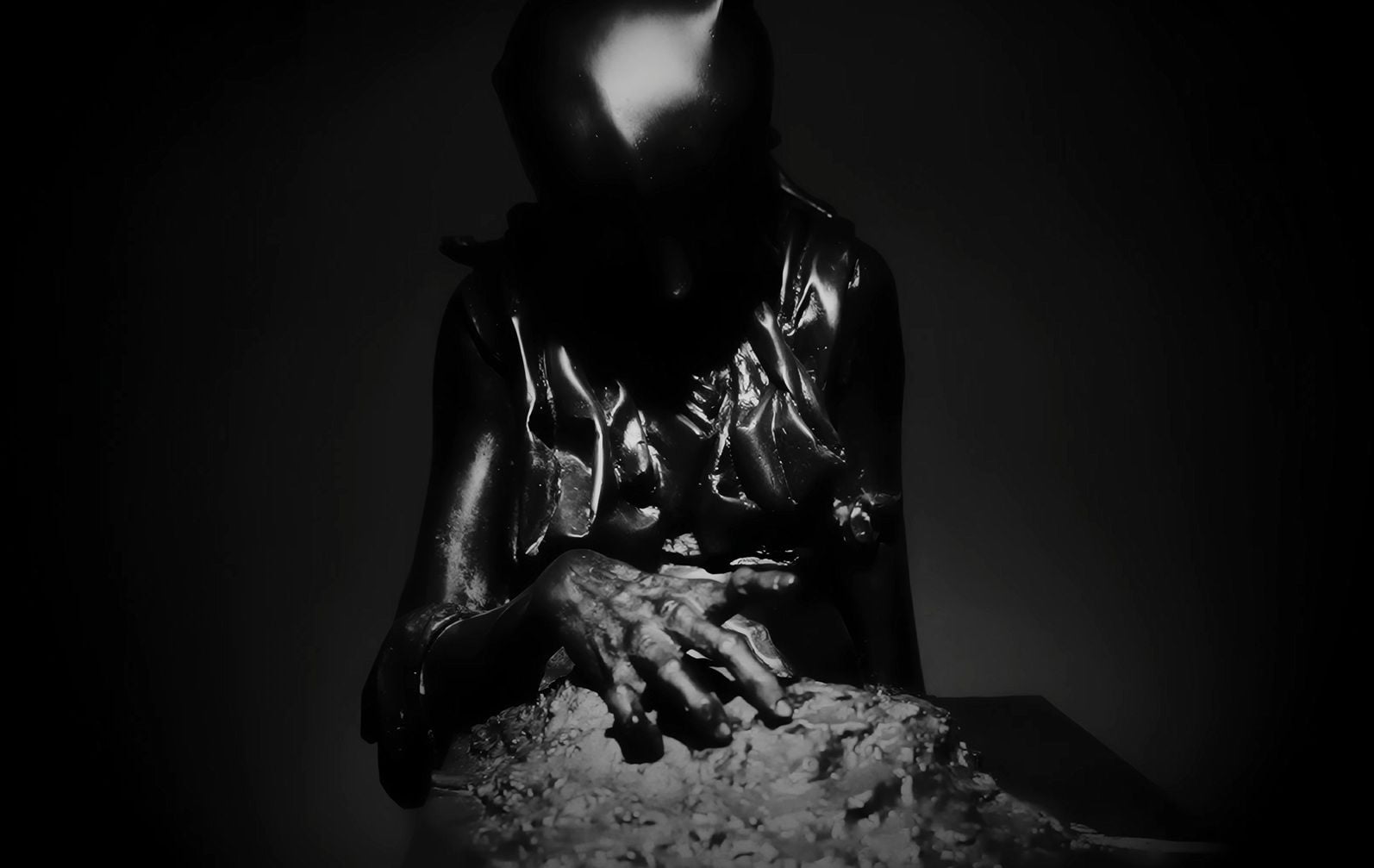
A sculpture does not perform. It does not speak. It does not offer another take. And yet, when you stand beside a large piece of bronze, you feel its weight, texture and presence immediately.
The problem for a filmmaker is simple to describe and difficult to solve:
How do you translate that physical presence into a moving image without reducing the work to a sequence of attractive details?
That question stayed with me while filming Romanian sculptor Ion Mândrescu.
Ion Mândrescu and I already knew each other before the documentary. We are friends, and that changed the process from the beginning.
I was not arriving with the curiosity of a stranger trying to “discover” an artist in a single day. I already knew something about the man, the work and the recurring ideas of man, time and space in his sculpture.
What interested me more was something less obvious.
I wanted to understand what happens when an artist stops explaining his work and simply exists beside it.
That is often where a portrait begins.
Not in the polished answer.
Not in the biography.
But in the pause, the gesture, the silence, the glance toward an object that has clearly lived with that person for years.
While filming Ion Mândrescu, I became less interested in proving that he is an important sculptor and more interested in giving the viewer enough time to feel his world: the bronze, the darkness, the fire, the studio, the thought before the sentence, and the strange calm that can appear when somebody begins to forget the camera.
That, for me, was the real subject of the film.
Bronze Does Not Move — So the Camera Has to Discover It
Sculpture is three-dimensional.
The camera is not.
If you simply place a lens in front of a sculpture and record it, much of what makes the object interesting can disappear.
Scale becomes ambiguous.
Texture becomes flatter.
A curve that changes dramatically when you walk around the work becomes a fixed silhouette.
So the camera has to discover the object.
Sometimes that means moving.
Sometimes it means allowing light to move across a surface while the camera remains still.
Sometimes it means placing the human body beside the sculpture so the viewer understands scale.
But while filming Ion Mândrescu, I became increasingly interested in the relationship between the artist and the bronze rather than treating the sculpture as an isolated object.
His hands.
His position beside a work.
The direction of his eyes.
The distance between the man and the object.
These things gave me information that a clean catalogue photograph never could.
The film therefore became not simply a film about sculptures.
It became a film about a sculptor living among them.
Night Changed the Visual Language
Part of the documentary was filmed at night.
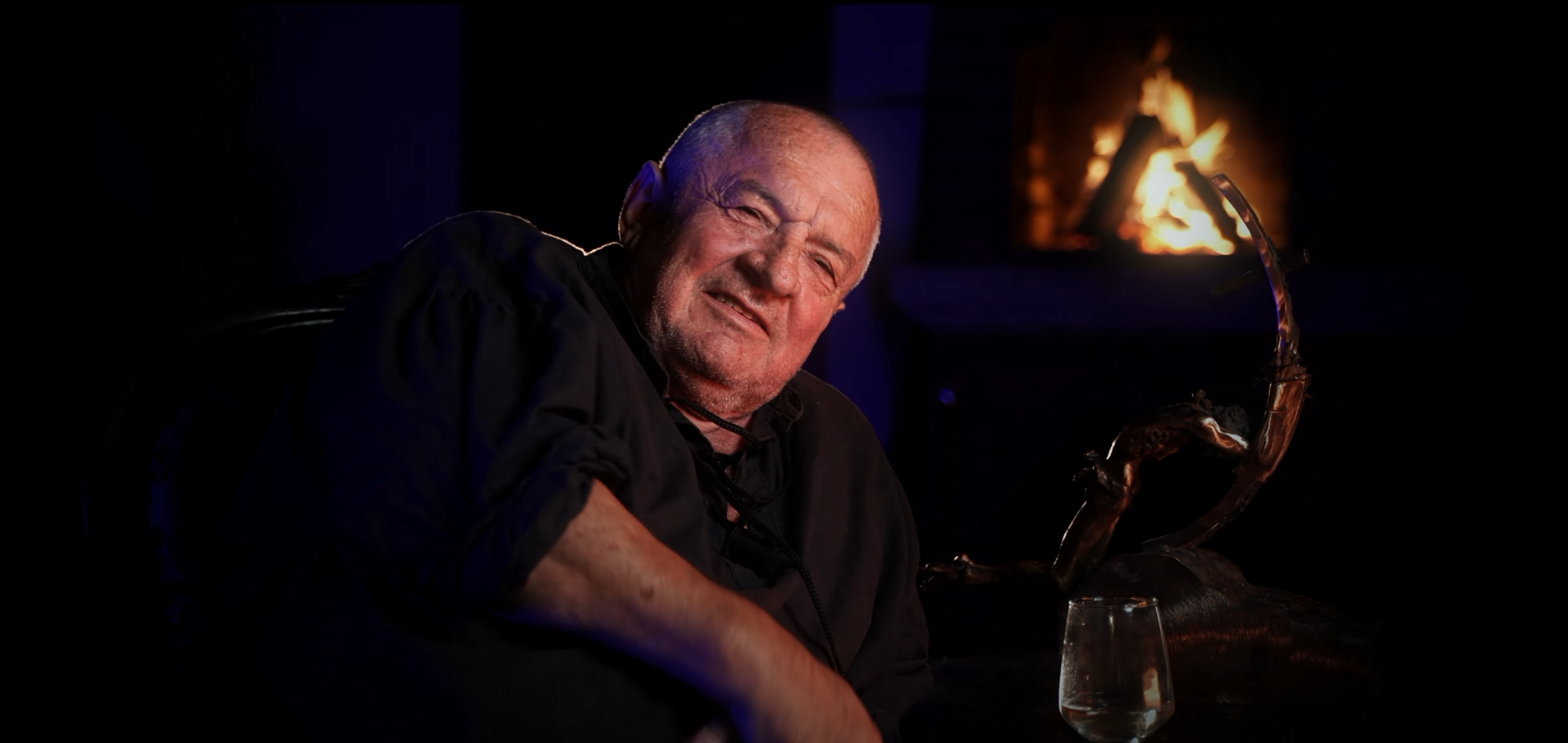
There was fire behind Ion Mândrescu, bronze beside him and the controlled light of the production working against darkness.
On paper, that can sound almost theatrical.
And that was precisely what I needed to control.
Fire is visually powerful.
Bronze is visually powerful.
Put the two together and it becomes very easy for the filmmaker to become more interested in the image than in the person.
You begin improving the shot.
Move the light.
Adjust the camera.
Find another angle.
Make it more dramatic.
And suddenly the filmmaking itself becomes the subject.
Documentary portraiture contains an interesting contradiction:
the more visible the production becomes, the more difficult it can be for the person in front of the camera to remain completely natural.
So once the technical structure was working, I tried to interfere less.
The image needed atmosphere.
But Ion Mândrescu still needed room to think.
A Good Interview Often Begins After the Answer
One thing I have learned from interviewing people is that the first answer is not always the most revealing one.
The camera changes people.
Someone who was speaking naturally thirty seconds earlier can suddenly become more formal when recording begins.
Vocabulary becomes tidier.
Posture changes.
The answer becomes something that sounds appropriate for an interview.
That is normal.
I do not fight it immediately.
I wait.
Quite often the interesting moment comes afterwards.
The polished answer ends.
There is a pause.
And then something else appears.
“Actually…”
“That is not exactly what I mean…”
“Let me explain…”
Those transitions matter.
With Ion Mândrescu, I was interested not only in what he said about sculpture, but also in the way he arrived at an idea.
A pause before an answer can tell you that someone is searching for something more precise than the first convenient sentence.
If the filmmaker immediately fills every silence with another question, those moments disappear.
Sometimes the correct directing decision is simply:
do nothing.
The Equipment Should Eventually Become Boring
I enjoy cameras, lenses, lighting and sound equipment.
After more than twenty years working with moving images, I still care enormously about the technical side.
But during a documentary interview, the equipment should eventually become uninteresting to the person sitting in front of it.
That requires preparation.
Exposure cannot become a discussion every five minutes.
Sound cannot continually interrupt the conversation.
Camera movement should not announce itself every time somebody says something important.
The technical work is still happening, but ideally it becomes almost reflexive.
That leaves more attention for the things that cannot be recreated later:
the expression that changes for half a second,
the hand that reaches toward an object,
the unexpected sentence,
the silence after it.
Technical competence matters because it creates the freedom to notice those things.
B-roll Is Not Decoration
The term “B-roll” can sometimes encourage the wrong way of thinking.
It sounds secondary.
Something to cover an edit.
Something useful when you need to hide a cut in an interview.
Of course it can perform those functions.
But in a documentary portrait, I want more from it.
While filming Ion Mândrescu, the objects around him were part of the story.
Bronze.
Tools.
Surfaces.
Fire.
The studio environment.
The physical relationship between the artist and his work.
Those images should not merely illustrate something that has already been said.
Ideally, they add something.
A sculpture shown after a particular sentence can change the meaning of that sentence.
A detail can suddenly become important because of something we heard earlier.
The same image can carry a completely different emotional weight depending on where it appears in the edit.
That is when coverage starts becoming storytelling.
The complete film and its production context are presented in the Ion Mândrescu documentary case study.
Sound Gives Weight to Physical Objects
Sculpture is visual.
But a film about sculpture cannot live only through images.
A physical environment has sound.
Movement has sound.
Fire has sound.
A room has a tone even when nobody speaks.
These elements help an image feel inhabited rather than merely photographed.
I am particularly interested in moments when sound does not call attention to itself.
A small environmental sound beneath a close shot can make a material feel more physical.
Silence can make a sentence heavier.
Removing sound can be as deliberate as adding it.
This is one reason I have never considered image, sound and editing completely separate disciplines.
They constantly change one another.
An image that seems ordinary can become emotionally precise when placed beside the right sound.
And a beautiful image can become meaningless when its soundtrack tells us something completely different.
Editing Is Where Time Becomes Part of the Portrait
Sculpture occupies physical space.
Film occupies time.
That difference became increasingly important during editing.
I did not want the documentary to feel like a sequence of information:
question,
answer,
sculpture,
another question,
another answer.
The viewer needed time to observe.
Sometimes that meant keeping a shot longer than a conventional promotional edit would allow.
It meant leaving pauses.
It meant allowing visual sequences to exist without immediately explaining them.
Modern editing makes compression extraordinarily easy.
We can remove almost every hesitation.
We can tighten every gap.
We can make somebody speak with a precision that person may never have possessed in real life.
Sometimes that is exactly what a film needs.
But sometimes the result becomes efficient and lifeless.
A documentary portrait needs rhythm, but rhythm does not mean constant speed.
The slower moments give the faster ones meaning.
Do Not Prove That the Subject Is Important
This may be the most useful lesson I took from the project.
A filmmaker can become too eager to prove the importance of the person being filmed.
Awards.
Exhibitions.
Achievements.
Titles.
Credentials.
All of those things may be relevant.
But if they become the main filmmaking strategy, the human being can disappear behind the résumé.
With Ion Mândrescu, I did not need the camera to continually tell the audience:
This is an important sculptor.
I wanted something more difficult.
I wanted the audience to spend enough time with the man and his work to form its own impression.
I did not want to prove that Ion Mândrescu is important. I wanted the viewer to feel why he matters.
That principle now influences much of my work beyond traditional documentary filmmaking.
When I create professional portraits and business stories, including the work developed through Profil Video, I am less interested in making somebody appear important than in giving the viewer enough evidence to understand why that person may be worth listening to.
That difference is small in language.
On screen, it is enormous.
The Filmmaker’s Job Is Partly to Disappear
There is a strange moment in a good interview when you feel the production beginning to disappear.
The lights are still there.
The cameras are recording.
The microphones are working.
Nothing has physically changed.
But the subject is no longer continuously aware of them.
That is usually when I become most attentive.
The filmmaking does not stop.
It becomes quieter.
I still think about framing, focus, sound, light and what the edit may eventually need.
But another part of my attention is now watching the person rather than the equipment.
For me, this balance has taken many years to understand.
My path through camera work, live production, sound, editing and documentary filmmaking is described in more detail on my Mugur Marin filmmaker profile.
After more than two decades working with moving images, I still care deeply about equipment and technique.
I simply no longer believe they are the most difficult part.
The difficult part is knowing what deserves attention.
With Ion Mândrescu, sometimes it was a sculpture.
Sometimes it was fire reflected on bronze.
Sometimes it was a sentence.
And sometimes it was the silence immediately after it.
That silence can tell you more about a person than another perfect answer ever will.