
AI-Generated Video Metadata: The Future of Content Discoverability
How AI Generates Smarter Metadata

The digital landscape is drowning in video content. Every minute, over 500 hours of video are uploaded to YouTube alone, creating an unprecedented challenge for content creators: how do you ensure your videos actually get discovered? The answer increasingly lies in artificial intelligence and its ability to generate sophisticated metadata that search engines and recommendation algorithms can understand.
Understanding Video Metadata in the AI Era
Video metadata encompasses all the information that describes your content. Titles, descriptions, tags, categories, transcripts, and even thumbnail data. Traditionally, creators manually crafted this metadata, a time-consuming process that often resulted in inconsistent or suboptimal descriptions. AI has fundamentally changed this paradigm by analyzing video content at scale and generating metadata that’s both accurate and optimized for discoverability.
Modern AI systems can watch your video content, understand the context, identify key moments, recognize objects and people, transcribe dialogue, and extract themes, all within minutes. This capability transforms metadata creation from a tedious manual task into an automated, data-driven process that consistently outperforms human-only approaches.
How AI Generates Smarter Metadata
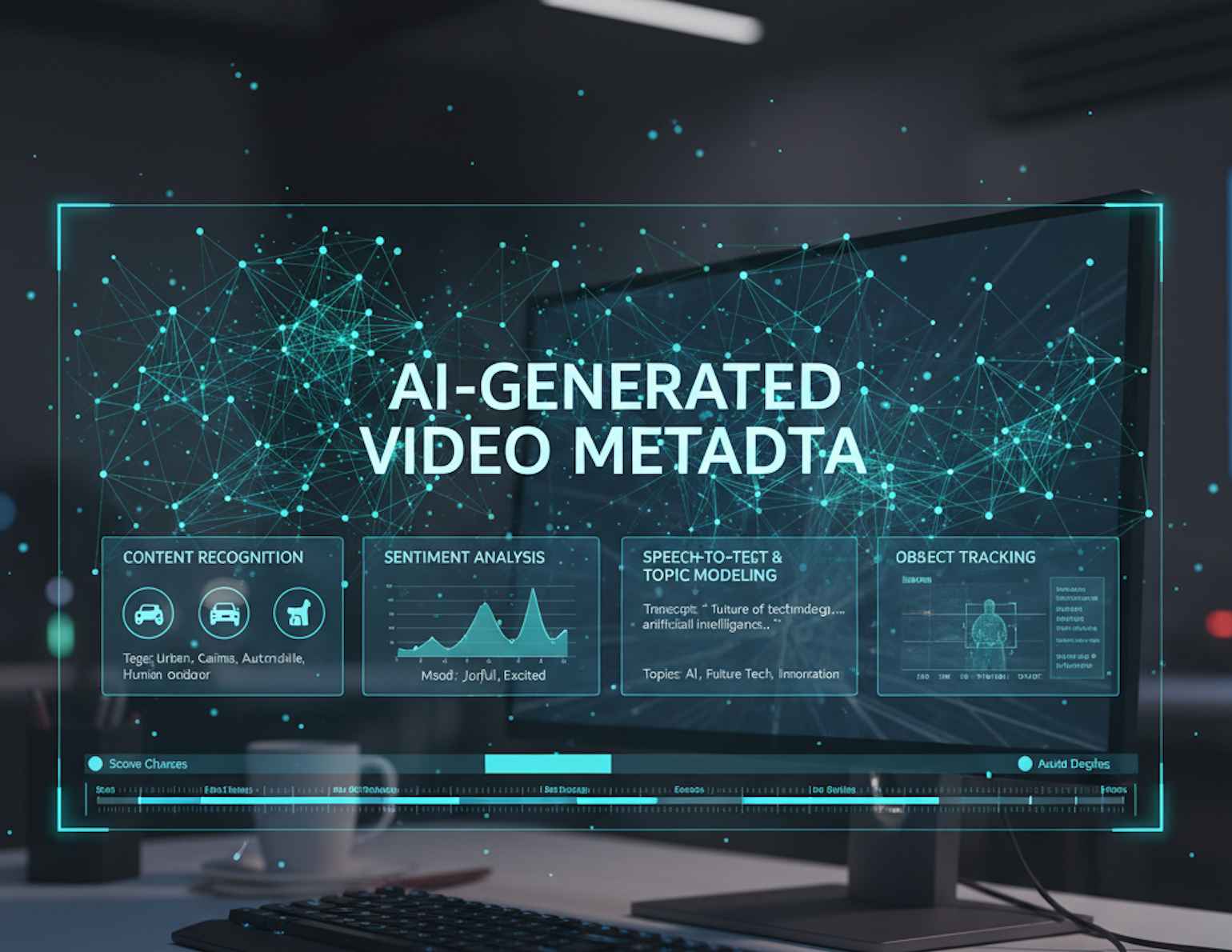
AI-powered metadata generation relies on several sophisticated technologies working in concert:
Computer Vision Analysis: Advanced neural networks scan every frame of your video, identifying objects, scenes, actions, and visual patterns. This allows the AI to understand what’s actually happening in the content, whether you’re showcasing products, demonstrating processes, or telling stories.
Natural Language Processing: AI transcribes spoken content with remarkable accuracy and analyzes the language used to identify topics, sentiment, and key concepts. For instance, an explainer video about complex topics can be automatically tagged with relevant technical terms and simplified descriptions for different audience levels.
Contextual Understanding: Modern AI doesn’t just identify individual elements. It understands relationships and context. It recognizes that a video featuring financial services discussions might need different metadata optimization than entertainment content, automatically adjusting its approach based on industry-specific requirements.
Multilingual Capabilities: AI can generate metadata in multiple languages simultaneously, dramatically expanding your content’s global reach without requiring human translators for every variant.
The Competitive Advantage of AI Metadata
The benefits of AI-generated metadata extend far beyond time savings:
| Benefit | Impact on Discoverability |
|---|---|
| Consistency | Maintains uniform metadata standards across the entire content libraries |
| Granularity | Identifies niche topics and long-tail keywords humans might miss |
| Speed | Enables same-day optimization for trending topics and current events |
| A/B Testing | Generates multiple metadata variants for performance testing |
| Semantic Richness | Creates interconnected metadata that helps algorithms understand content relationships |
Consider a company producing product videos across multiple categories. AI can analyze each video and generate metadata that connects related products, suggests complementary content, and ensures consistent terminology. Something that would require a dedicated generator set of rules and countless hours to accomplish manually.
Practical Applications Across Industries
Different sectors are leveraging AI metadata in innovative ways:
E-commerce brands use AI to automatically tag product features, colors, use cases, and complementary merchandise within product demonstration videos. This enables shoppers to find exactly what they’re looking for through search, even if the video creator didn’t explicitly mention every detail.
Educational platforms employ AI to create detailed chapter markers, learning objectives, and difficulty ratings for instructional content, making it easier for students to find relevant materials and for algorithms to recommend appropriate next steps.
Media companies utilize AI to generate episode summaries, character appearances, plot points, and thematic tags across massive content libraries, enabling sophisticated search and recommendation features that keep viewers engaged.
Corporate communications teams leverage AI to ensure internal training videos, announcements, and documentation are properly categorized and searchable across enterprise systems.
Implementing AI Metadata in Your Workflow
Successfully integrating AI-generated metadata requires a strategic approach:
Start with Quality Content: AI metadata is only as good as your underlying content. Ensure clear audio, good lighting, and coherent messaging before optimization begins.
Choose the Right Tools: Evaluate AI platforms based on your specific needs. Some excel at e-commerce applications, others at educational content, and still others at entertainment optimization.
Maintain Human Oversight: While AI generates impressive metadata, human review ensures brand voice consistency and catches edge cases where AI might misinterpret context or nuance.
Iterate and Refine: Use performance analytics to understand which AI-generated metadata drives results. Feed this information back into your process to continuously improve outcomes.
Combine with SEO Best Practices: AI metadata works best when integrated with broader SEO strategies, including keyword research, competitor analysis, and audience intent mapping.
The Future of Video Discovery
As AI technology continues evolving, we’re moving toward a future where video content becomes as searchable and discoverable as text. Emerging capabilities include:
Predictive Metadata: AI that anticipates trending topics and preemptively optimizes content before trends peak.
Emotional Intelligence: Systems that understand and tag the emotional tone and impact of content, enabling new dimensions of personalization.
Interactive Metadata: Dynamic descriptions that change based on viewer context, preferences, and viewing history.
Cross-Platform Optimization: AI that generates platform-specific metadata optimized for YouTube, TikTok, Instagram, and emerging platforms simultaneously.
The implications are profound. Smaller creators gain access to enterprise-level optimization capabilities. Niche content finds its audience more efficiently. The discovery process becomes less dependent on algorithmic luck and more on genuine relevance.
Conclusion
AI-generated video metadata represents more than an efficiency improvement. It’s a fundamental shift in how content gets discovered and consumed. As video continues dominating digital communication, the ability to automatically generate rich, accurate, and optimized metadata becomes a critical competitive advantage.
The creators and organizations that embrace this technology now will build sustainable discoverability advantages, while others struggle with manual processes that can’t scale. The future of content isn’t just about what you create. It’s about ensuring your audience can actually find it. AI-generated metadata is the key that unlocks that future.