
How to Manage Client Feedback on Video Projects Without the Back-and-Forth
Scattered revisions and email chaos slow every video project. Here's how professional videographers keep feedback organized and get projects approved faster.

If you’ve been doing video work for more than a few months, you know the feeling. You send a cut. Your client responds four days later, across three different channels, with notes that partially contradict what they said in the brief. By the time you’ve figured out which feedback is current and which version they’re actually referring to, you’ve lost a full day — and you haven’t touched the timeline yet.
Client feedback is the most chaotic part of any video project. And it doesn’t have to be.
The professionals who consistently deliver great work on schedule aren’t tolerating less feedback or working longer hours. They’ve built a system that makes revisions predictable and manageable. Here’s how they do it.
Why Video Feedback Goes Off the Rails
Before you can fix the problem, it helps to understand why it happens so reliably.
Most clients don’t think of feedback as a structured process. They’re busy, non-technical, and used to responding casually — over email, a Slack message, a voice note, or a vague phone call after a screening. Every one of those formats is a separate place you now have to check and reconcile.
The result is what most editors call feedback scatter: five sources of truth, none of which fully agree, and you’re responsible for making sense of all of it.
The second issue is version confusion. When you send V1, V2, and V3_FINAL through email or WeTransfer, clients lose track of which link is current. You then receive detailed notes on a version you revised two rounds ago — and end up doing the same work twice.
These are structural problems. They don’t go away by asking clients to be more organized. They go away when you give clients the right structure to work within.
Set Revision Terms Before the Project Starts
The most effective thing you can do happens before a single frame is edited. Define revision rounds upfront, in writing, as part of your contract or project brief.
A clear structure looks something like this:
- Round 1 — Structural feedback only: pacing, story arc, major cuts. No color notes, no music changes, no text edits.
- Round 2 — Fine-tuning: specific timing, sound mix, color palette direction.
- Round 3 — Final polish: minor corrections only.
When clients understand this structure before the project begins, they naturally batch their notes and focus on what’s appropriate for each stage. Fewer rounds, more useful feedback, less back-and-forth.
Put the number of included revision rounds in your contract and be explicit about what out-of-scope requests cost. This isn’t about being inflexible — it’s about protecting the project’s momentum for both sides.
Consolidate All Feedback Into One Place
The biggest workflow upgrade most videographers can make is eliminating feedback scatter before it starts.
Trying to collect client notes through email, Slack, WhatsApp, and phone calls is like running a construction site where instructions come from six managers with no central command. Even when each piece of feedback is useful, combining it all is chaos.
The solution is picking one channel and enforcing it — ideally one built for the job.
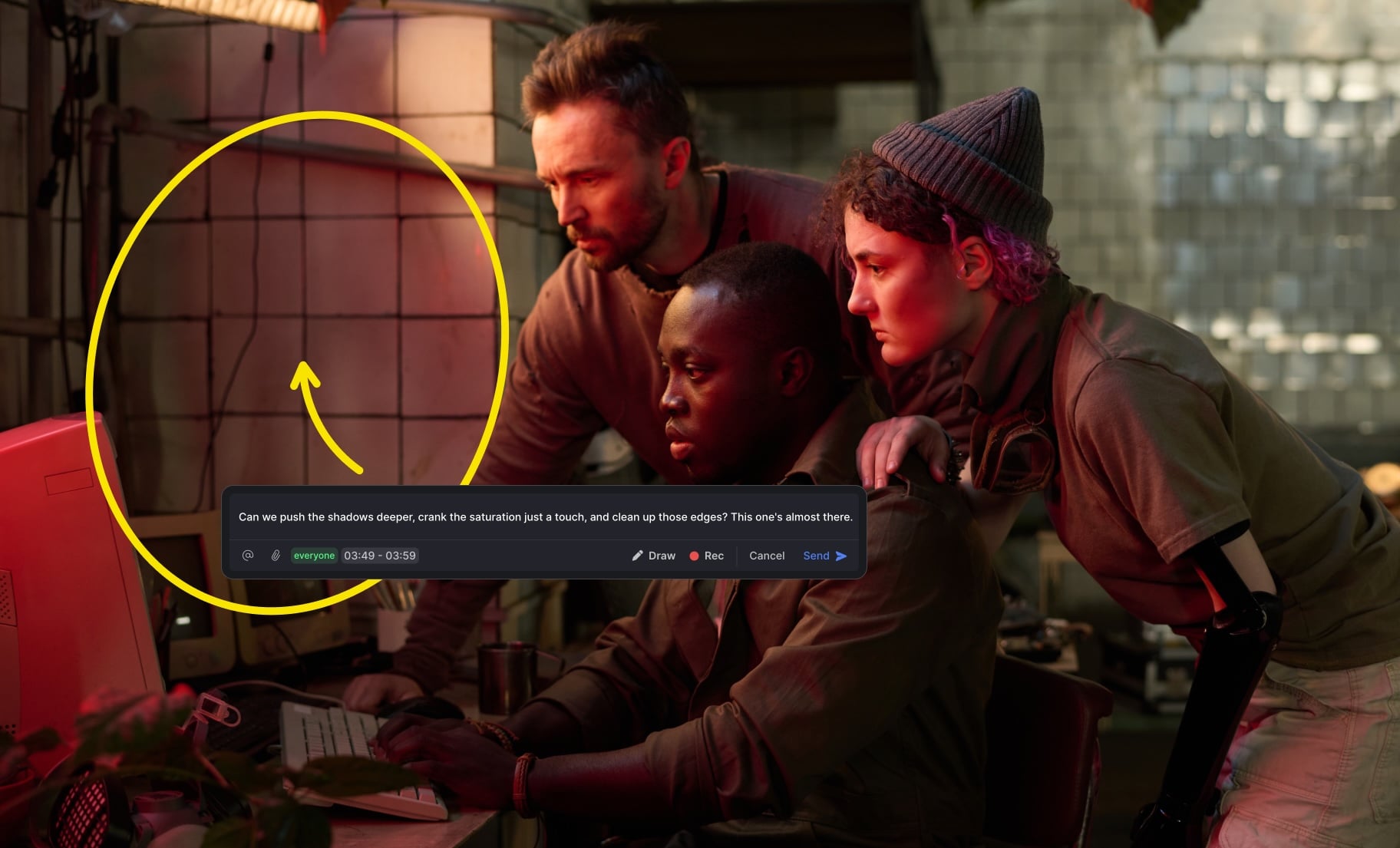
Dedicated video review software solves this at the infrastructure level. Instead of sending a download link, you share a review link. Clients watch the video in their browser and leave frame-accurate, timestamped comments directly on the moment they’re referencing. No more “around the 1:20 mark, sort of…” — they click the frame, they leave the note, and it’s attached to the exact second they mean.
What makes this approach so effective isn’t just the timestamping — it’s the visibility. You can see who has watched the video, what feedback is outstanding, and where the project stands in the approval process. No more following up blind.
Get Every Stakeholder Into Round 1
One of the most expensive mistakes in video production is seeing key decision-maker feedback arrive late.
It goes like this: you’ve built a tight, approved cut with your primary client contact. Then, one week before delivery, their CMO watches it for the first time and has major structural notes. You’re now rebuilding a project you thought was done.
This happens because stakeholders with approval authority often aren’t involved until the work looks nearly finished. By then, expectations have solidified on both sides — and course corrections are far more costly.
The fix is identifying every person with sign-off authority at the kickoff stage. Invite all of them to review Round 1, even if only one person’s feedback is binding. Getting eyes on the work early catches structural issues while they’re still fast to fix.
Good review platforms make this easy. You can invite as many reviewers as needed with a single link — no extra accounts, no per-user fees.
Use Version Control to Eliminate Confusion
Sending video files through email or generic file-sharing services creates a version control problem almost immediately. Files get downloaded, renamed, re-shared, and eventually nobody’s sure which cut is current.
A few simple habits eliminate this entirely:
- Never overwrite a previous version. Always save as V2, V3, V4 — never “Final” or “Final_FINAL.”
- Archive approved versions so you and the client can refer back to what was agreed on.
- Make the current version obvious. Whether you’re using a review platform or cloud storage, the active file should be impossible to miss.
When clients can see a clear version history, they stop second-guessing what changed. They can compare two rounds side by side, understand what was addressed, and give feedback that’s actually relevant to where the project stands now.
Separate Internal Notes from Client-Facing Feedback
Here’s a subtler habit that pays off on larger projects: never let clients see your internal team notes.
When editors and producers leave comments for each other — about technical fixes still pending, rough elements to revisit, or internal debate about a creative decision — those notes can confuse or alarm clients who stumble across them. “Why does it say the color is broken?” is a question you don’t want to answer mid-review.
The cleanest solution is using a platform that separates internal and client-facing comment threads. Your team can have a full technical conversation about the cut without any of it being visible to the client you’re presenting it to.
This matters especially on agency projects, where you may be managing feedback from both the agency and their end client simultaneously — two very different audiences with very different concerns.
Send a Clear Approval Request at the Finish Line
Many projects stall at the very end because the client isn’t sure whether they’re supposed to do anything.
When you’re ready for final sign-off, send a specific, low-friction email:
- Link to the final version
- A short paragraph summarizing what changed since the last round
- A direct ask: “Please confirm your approval by [date] so we can finalize delivery.”
- A deadline that gives you buffer before your actual hard deadline
A clear, simple request gets a clear, simple answer. It also creates a paper trail — which matters if scope creep or disputes come up later.
Build a Workflow Clients Can Trust
Managing feedback well isn’t about being rigid. It’s about being professional with everyone’s time.
When clients have a clear process to work within, they feel more confident, not more restricted. They know what to expect, when they’ll see the next version, and what their role is at each stage. The videographers who build lasting client relationships are the ones who make collaboration feel organized and in control — even on complex, multi-deliverable projects.
Clear revision terms, a single feedback channel, proper version control, and a structured approval process aren’t bureaucratic overhead. They’re the foundation of a production workflow clients respect and recommend.